Aug 5, 2010
Boeung Kak land reclassified
LARGE portions of the city’s Boeung Kak lakeside have been reclassified as state private property under the joint control of City Hall and the local company behind the controversial filling of the lake, according to a recent sub-decree.
The document, signed by Prime Minister Hun Sen on July 20, states that 126.85 hectares of the lake and its surroundings are to be “considered as a state private property for Shukaku Inc Company to develop based on the government’s purpose”.
“The area mentioned above is legally managed and controlled by related Ministries and Phnom Penh Municipal Hall with the cooperation of Shukaku Inc Co Ltd,” the sub-decree states. Unlike state public land, which includes lakes, rivers, roads and parks, state private land can be legally leased or sold to companies or individuals.
In February 2007, Shukaku, an obscure local firm owned by Cambodian People’s Party Senator Lao Meng Khin, signed a lease agreement with the municipality giving it the right to develop the lakeside, then a state public property. The following year, it began filling in the lake to make way for a 133-hectare housing and commercial development at the lakeside. Housing rights advocates say that more than 4,000 families will be displaced by the project.
Phnom Penh Deputy Governor Pa Socheatvong confirmed that the area contained in the sub-decree had been classified as state private land for some time, but did not give any reason for the reclassification.
“Before [the lake] was state public land, so government could not rent it to a private company to develop it. They have to reclassify it as state private land in order that the private company gets the legal right to develop that area,” he said.
The recent sub-decree followed a similar subdecree issued in August 2008, which also claimed to have reclassified the lake as state private land.
David Pred, executive director of Bridges Across Borders Cambodia, said yesterday that the new sub-decree – like the earlier sub-decree – was an attempt to provide “retrospective legal cover” for the 2007 lease agreement.
“The state did not have the right to lease the lake and surrounding land at that time, because the lake is state public property, which cannot be subject to long-term leases,” he said. He said that many of the lakeside families had a legal right to their land.
Pred also described the new sub-decree as “puzzling” in that it referred to 126 hectares rather than the 133 hectares that were leased in 2007.
“This may be an indication that the Council of Ministers recognises some of the land that was originally leased to Shukaku as private land,” he said, and called on the Council to disclose to residents the exact boundaries of the development area.
“Those who fall outside those boundaries should be given land titles without further delay,” he added.
Representatives of Shukaku Inc could not be reached for comment yesterday. The company’s office address, as listed in the Yellow Pages, is an empty lot on Street 114, and the phone number connects to a restaurant in another part of the city.
Duy Thov, deputy secretary general of the Council for the Development of Cambodia, declined to comment.
News from PhnomPenhPost
ECCC To Publish 22,000 Books of Duch’s Verdict
CAMBODIA, PHNOM PENH, AUGUST 5, 2010-UN-back tribunal officials on Thursday said that it will publish a series book of its first verdict of notorious S21 chief of Khmer Rouge regime.
Reach Sambath, head of ECCC public affair, told reporters during a press tour to a printing house where it will publish 22,000 books. The amount of money is not revealed but it will use ECCC budget.
The verdict against Kaing Guek Eav, alias Duch, also convicted him of crimes against humanity, murder and torture. It was a historic first for a U.N.-backed war crimes tribunal.
Duch, 67, was the head of the S-21 prison, where at least 14,000 people died.
The verdict against Kaing Guek Eav, alias Duch, also convicted him of crimes against humanity, murder and torture.
Thailand Must Stop Talking about Opposition of Management Plan of Preah Vihear Temple
CAMBODIA, PHNOM PENH, AUGUST 5, 2010-Thailand still has choice for border talks with Cambodia in case that Thailand stopped talking about opposition of management plan of 11th century Khmer Preah Vihear temple and stopped claim that 4.6 square km area as Thai soil.
Thai side should persuade border demarcation at area near Preah Vihear if Thailand wants to have good relationship with Cambodia by using MOU 2000 and 1904-1907 border treaty for border demarcation. Thailand also recognized that Preah Vihear as Cambodia.
Cambodia does not give the sign for meeting of dealing the border issues with Thailand because Thailand opposed the management plan of Preah Vihear temple and no ambassador.
Actually, Cambodia wants to talk about border issues but the last development of the border issues and opposition of management plan from Thai side that is obstacle. Military unit is good ties.
Phnom Penh administration did not give the signal for Thai PM Abhisit who planned to send DPM Suthep because some Thai officials said too much about opposition of management plan, border issues and Thai side does not approve the border deal which agreed so far. Border demarcation plan got stuck in Thai hands. Thai PM still has hope for bilateral talks.
To have good ties between Cambodia and Thailand, Thailand has to do such as
1- Thailand must pursue the border demarcation agreement that agreed so far by the border committee. Go together with Cambodia border committee to measure the area to plant border post. Actually, land is Cambodia.
2- Stop talking about opposition of management plan but Thai side need to express good wills in dealing border issues by using MOU 2000 and border treaty 1904-1907. And Thai side stopped using border map which drawn by military secretly in1976.
3- Stop using border issuer as tool for political benefits.
4- Thai side should believe that management plan is in places of Cambodian soil only.
5- Ambassador should send back without waiting until Thai general election, it will connect good relation. Former Thai PM Thaksin now stays far from Cambodia. Cambodian constitution does not allow foreigners to use Cambodia as stronghold to struggle power in other countries.
6- Thailand should ask China for helping to connect diplomatic ties with Cambodia.
7- Prince Sisowath Thomico’s letter is enough for Thai side to understand about border issues. Prince also is in Beijing.
Author Undertakes Battambang School Rehabilitation
The author of a Khmer Rouge memoir who now lives in the US is raising funds to help education in Cambodia.
Ung Kilong, the 50-year-old author of “The Golden Leaf,” said he hopes better education will promote free thinking and a break from the kind of political ideology that led to the disaster of the Khmer Rouge.
“Young people joined the Khmer Rouge because they lacked understanding,” he said. “With the schooling in place they will have more knowledge.”
Ung Kilong is working with a group of associates to build a primary school in Thmor Kol district, Battambang province, where students are taught by underpaid teachers in a dilapidated school and without proper uniforms.
Ung Kilong is himself originally from Battambang, but he fled to the US with his sister following the Khmer Rouge and the loss of their parents and other siblings.
“I was lucky to come here, so I want to help Cambodia, so that in the future, Cambodian children can raise up the face of the country,” Ung Kilong told VOA Khmer from Portland, Oregon, where he was fundraising for the school project.
Cambodia’s ambassador to the US, Hem Heng, who attended the fundraising ceremony, urged other Cambodians to do more to help education, health and social issues.
“As Cambodians, no matter where we go and no matter what citizenship we hold, our blood is still Khmer,” he said. “Therefore, we always think of our country.
News from VOANEWS
Former King and Queen Mother donates 10,000 US dollars to Cambodian Red Cross
King Father and King mother of Cambodia
Former King Norodom Sihanouk and queen monther Norodom Monineat has donated 10,000 US dollar to Cambodian Red Cross for helping in humanitarian affairs especially poor and vunerble people, the statement signed by the couple from Beijing obatined on Wednesday said.
The couple majesties also congraluated the general assembly of the Cambodian red Cross and praised Lok Chum teav Bun Rany Hun Sen, as chairwoman of the red cross,” the statement noted.
We all thanked for your role in contribution of helping poor and victims, and general citiziens,” the statement noted.
We all praised all staff of Cambodian red cross and highest chariwoman who conducted general assembly which will provided the benefits for our people,” it added.
This morning, Cambodian red Cross also chose 26 new members for leading its agencies to achiveve its goals. King Norodom Sihamoni also presided over the closing ceremony of the general assembly at Chaktomuk conference hall in Phnom Penh.
News from DAP-NEWS
Former King Norodom Sihanouk and queen monther Norodom Monineat has donated 10,000 US dollar to Cambodian Red Cross for helping in humanitarian affairs especially poor and vunerble people, the statement signed by the couple from Beijing obatined on Wednesday said.
The couple majesties also congraluated the general assembly of the Cambodian red Cross and praised Lok Chum teav Bun Rany Hun Sen, as chairwoman of the red cross,” the statement noted.
We all thanked for your role in contribution of helping poor and victims, and general citiziens,” the statement noted.
We all praised all staff of Cambodian red cross and highest chariwoman who conducted general assembly which will provided the benefits for our people,” it added.
This morning, Cambodian red Cross also chose 26 new members for leading its agencies to achiveve its goals. King Norodom Sihamoni also presided over the closing ceremony of the general assembly at Chaktomuk conference hall in Phnom Penh.
News from DAP-NEWS
Cambodia PM Hun Sen Warns about Flood of Mekong River
CAMBODIA, PHNOM PENH, AUGUST 5, 2010-Cambodian PM Hun Sen on Thursday warned the local people and authorities about the flood of Mekong River in near future.
We have known that the water level of upper Mekong River has risen so quicker and our authorities have to be careful about that water level that could lead to the flood for local people,” He told the closing ceremony of the general assembly of the Cambodian Red Cross.
Rainy season has hit Cambodia and rainy monsoon also covered the country. Cambodia always about the water current for Mekong River that could affect about the natural resources including rare Mekong Dolphin, and fish population, and offspring for fish this year after the offspring season is late for fish because water level still is lower than normal time in previous years.
Now, water level in Laos rose and Mekong River at lower stream affected from this but it will see the situation later.
Aug 2, 2010
The rice is right: Exports skyrocket
EXPORTS of milled rice surged by about 2,360 percent in the first six months of this year compared to 2009, after the government encouraged production of Cambodia’s “white gold”.
In the past six months, the government has spearheaded a raft of measures aimed at boosting the country’s rice-export capacity.
Officials updated the national rice policy, doubled Rural Development Bank capital to US$36 million and scrapped licence requirements for exporters to spur development.
The government hopes to improve the quality of Cambodia’s rice to increase exports to foreign markets, such as Europe. The measures so far appear to have had a marked effect.
Data released by the Ministry of Commerce’s CamControl department showed that just 4,369 tonnes of milled rice was exported from January to June 2009.
But in the first half of this year, the Kingdom sent 107,291 tonnes of milled rice abroad – an increase of 2,356 percent. Exports were worth $13.438 million this half, up from $2.193 million in 2009.
Cambodian officials have welcomed the increase.
“Since the government encouraged development, we have seen [the sector] improve dramatically — in terms of both farming methodology and production capacity,” said director of Information and Statistics Department at the ministry, Kong Putheara.
He said that last year, the government installed tax preferences for foreign investors, and that the European Union allowed more Cambodian rice to enter its markets, sparking growth.
President of the Cambodian Rice Millers’ Association, Phou Puy, hailed the figures as a “starting point” for Cambodia to produced high-quality rice in line with neighbouring countries such as Thailand and Vietnam.
But he warned challenges were still ahead as companies sought footholds internationally.
“We don’t know clearly about the market so we have to look for [buyers] and sell at lower prices to get the market share,” he said. “Next year will be the time to export as much as we can.”
A secretary of state for the Ministry of Agriculture, Chan Tong Ive, said that an open agricultural policy had changed business patterns for some farmers, who had shifted into intensive farming that upped yields.
News from PhnomPenhPost
Fishermen Say They Are Forced Into Illegal Catches
Commercial fishing for the next three months is forbidden.
Local fishermen on the Tonle Sap lake in the province of Battambang say they continue to fish illegally during the off-season.
In interviews with VOA Khmer, the fishermen said they have no choice but to continue fishing, sometimes with banned equipment, in order to feed their families, despite a three-month ban instituted by the government that begins each July.
“The ban is like breaking our rice pot,” said 53-year-old fisherman Chhun Leang.
He sat in a wooden house on the great lake, in the floating village of Anlung Ta Our, in Ek Phnom district, and when boats passed their wakes shook his home.
“Unlike the people on land who are farmers, we fishermen have no land for farming,” he said. “We only depend on fishing.”
Commercial fishing for the next three months is forbidden. This is the breeding season. Small nets and handmade gear are allowed, but fishermen like Chhun Leang say that isn't enough.
He earns about $250 a month, working a medium-sized net rig that is banned this time a year. Even if these were permitted, he said, these days he barely catches enough fish to feed his family.
“So despite the ban, myself and other fishermen in the commune still secretly fish with our rigging,” he said. There are crackdowns, he said, but he keeps fishing. “Otherwise, we cannot survive.”
His neighbor five houses down, Yon Phann, agreed.
“If we didn’t do it, we would have nothing to eat,” he said, looking at fishing nets hanging on a nearby wall. “Fishing is our farming here.”
More than 70 percent of the 10,000 people living in this commune, Koh Chi Verng, are fishermen. The rest sell goods or repair boats.
Commune Chief Bun Beng said that every year people face hard times during the three-month ban, so at times he turns a blind eye to some illegal fishing.
“They can catch just a kilo or two of fish a day, and they sell it for rice to eat,” he said in an interview at his own floating house. “This is all they can do here because we have no rice to harvest.”
On the other hand, he said, he advises people not to use heavy rigging during the ban, and he encourages them to breed fish and raise eels to supplement their catches.
Nao Thuok, head of Agriculture Ministry’s fishery administration, said there is no exception for any particular fishing community in the use of banned gear this season.
“Any such act will be cracked down on,” he said. “This is according to the law, which must be implemented to benefit all the people across the country, not just that particular community or a small number of others.”
“All floating communities around the Tonle Sap should only fish for family consumption during this ban season,” he said, “so that more fish can breed for them to catch at the end of the season.”
News from VOANEWS
Local fishermen on the Tonle Sap lake in the province of Battambang say they continue to fish illegally during the off-season.
In interviews with VOA Khmer, the fishermen said they have no choice but to continue fishing, sometimes with banned equipment, in order to feed their families, despite a three-month ban instituted by the government that begins each July.
“The ban is like breaking our rice pot,” said 53-year-old fisherman Chhun Leang.
He sat in a wooden house on the great lake, in the floating village of Anlung Ta Our, in Ek Phnom district, and when boats passed their wakes shook his home.
“Unlike the people on land who are farmers, we fishermen have no land for farming,” he said. “We only depend on fishing.”
Commercial fishing for the next three months is forbidden. This is the breeding season. Small nets and handmade gear are allowed, but fishermen like Chhun Leang say that isn't enough.
He earns about $250 a month, working a medium-sized net rig that is banned this time a year. Even if these were permitted, he said, these days he barely catches enough fish to feed his family.
“So despite the ban, myself and other fishermen in the commune still secretly fish with our rigging,” he said. There are crackdowns, he said, but he keeps fishing. “Otherwise, we cannot survive.”
His neighbor five houses down, Yon Phann, agreed.
“If we didn’t do it, we would have nothing to eat,” he said, looking at fishing nets hanging on a nearby wall. “Fishing is our farming here.”
More than 70 percent of the 10,000 people living in this commune, Koh Chi Verng, are fishermen. The rest sell goods or repair boats.
Commune Chief Bun Beng said that every year people face hard times during the three-month ban, so at times he turns a blind eye to some illegal fishing.
“They can catch just a kilo or two of fish a day, and they sell it for rice to eat,” he said in an interview at his own floating house. “This is all they can do here because we have no rice to harvest.”
On the other hand, he said, he advises people not to use heavy rigging during the ban, and he encourages them to breed fish and raise eels to supplement their catches.
Nao Thuok, head of Agriculture Ministry’s fishery administration, said there is no exception for any particular fishing community in the use of banned gear this season.
“Any such act will be cracked down on,” he said. “This is according to the law, which must be implemented to benefit all the people across the country, not just that particular community or a small number of others.”
“All floating communities around the Tonle Sap should only fish for family consumption during this ban season,” he said, “so that more fish can breed for them to catch at the end of the season.”
News from VOANEWS
Aug 1, 2010
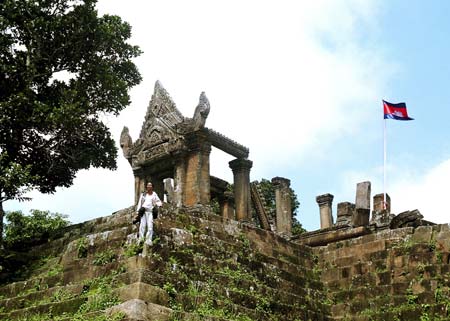
Temple tension mounts
Preah Vihear Temple, Cambodia
CAMBODIAN and Thai officials held abortive talks on the sidelines of the UNESCO World Heritage Committee meeting in Brazil yesterday in a last-ditch attempt to resolve a dispute over Cambodia’s management plan for Preah Vihear temple.
Phay Siphan, spokesman for the Council of Ministers, said that during the 45-minute meeting, Deputy Prime Minister Sok An and Thai Natural Resources and Environment Minister Suwit Khunkitti reiterated their governments’ stances on the temple listing.
He said the Thai official demanded joint management of Preah Vihear, and that Sok An repeated Cambodia’s long-standing opposition to such an arrangement.
“There was no significant result from the meeting. The meeting focused on the issue of sovereignty,” Phay Siphan said, but Cambodia “welcomed” UNESCO’s attempt to broker a resolution to the conflict.
The 21-member WHC, which is meeting until Tuesday, was to note the submission of Cambodia’s management plan for Preah Vihear late yesterday, and the lead-up to the session has prompted a fresh flare-up in the long-standing temple dispute.
Thailand has opposed Preah Vihear’s listing as a World Heritage site since before its July 2008 inscription, claiming sovereignty over a 4.6-square-kilometre area adjacent to the temple.
On Wednesday, Thai Prime Minister Abhisit Vejjajiva threatened that if the WHC approved the Cambodian plan, Bangkok would consider withdrawing from UNESCO.
The Associated Press also quoted Abhisit as saying that the committee should act as a “purveyor of peace and culture, not of tension and conflicts”, and that the Thai army was ready to defend the country’s sovereignty.
Cambodian officials, however, have dismissed the Thai claims, pointing to a 1962 ruling by the International Court of Justice that handed the temple – and surrounding lands – to Cambodia.
Phay Siphan said the Thai threats of noncooperation with UNESCO were an “insult” to the world body.
“Thailand will not gain if they walk out of the WHC because Thailand has many tourism sites [listed as] World Heritage sites,” he said. “The obligation of Cambodia is to implement the decision from the WHC, and we have done that since 2008.” He described the management of Preah Vihear as an “absolutely technical matter”.
UNESCO spokeswoman Sue Williams said yesterday that the dispute between Cambodia and Thailand was “a strictly bilateral” issue, and that the WHC had no mandate to address it.
She also said that Thai talk of the WHC “approving” the Cambodian management plan was misguided.
“The World Heritage Committee does not adopt or approve any plans. All they can do is note that the management plan has been submitted,” she said. Williams added that all member states had the right to withdraw from UNESCO, but that Thailand’s potential withdrawal would not affect the status of any of its World Heritage sites.
News from PhnomPenhPost
CAMBODIAN and Thai officials held abortive talks on the sidelines of the UNESCO World Heritage Committee meeting in Brazil yesterday in a last-ditch attempt to resolve a dispute over Cambodia’s management plan for Preah Vihear temple.
Phay Siphan, spokesman for the Council of Ministers, said that during the 45-minute meeting, Deputy Prime Minister Sok An and Thai Natural Resources and Environment Minister Suwit Khunkitti reiterated their governments’ stances on the temple listing.
He said the Thai official demanded joint management of Preah Vihear, and that Sok An repeated Cambodia’s long-standing opposition to such an arrangement.
“There was no significant result from the meeting. The meeting focused on the issue of sovereignty,” Phay Siphan said, but Cambodia “welcomed” UNESCO’s attempt to broker a resolution to the conflict.
The 21-member WHC, which is meeting until Tuesday, was to note the submission of Cambodia’s management plan for Preah Vihear late yesterday, and the lead-up to the session has prompted a fresh flare-up in the long-standing temple dispute.
Thailand has opposed Preah Vihear’s listing as a World Heritage site since before its July 2008 inscription, claiming sovereignty over a 4.6-square-kilometre area adjacent to the temple.
On Wednesday, Thai Prime Minister Abhisit Vejjajiva threatened that if the WHC approved the Cambodian plan, Bangkok would consider withdrawing from UNESCO.
The Associated Press also quoted Abhisit as saying that the committee should act as a “purveyor of peace and culture, not of tension and conflicts”, and that the Thai army was ready to defend the country’s sovereignty.
Cambodian officials, however, have dismissed the Thai claims, pointing to a 1962 ruling by the International Court of Justice that handed the temple – and surrounding lands – to Cambodia.
Phay Siphan said the Thai threats of noncooperation with UNESCO were an “insult” to the world body.
“Thailand will not gain if they walk out of the WHC because Thailand has many tourism sites [listed as] World Heritage sites,” he said. “The obligation of Cambodia is to implement the decision from the WHC, and we have done that since 2008.” He described the management of Preah Vihear as an “absolutely technical matter”.
UNESCO spokeswoman Sue Williams said yesterday that the dispute between Cambodia and Thailand was “a strictly bilateral” issue, and that the WHC had no mandate to address it.
She also said that Thai talk of the WHC “approving” the Cambodian management plan was misguided.
“The World Heritage Committee does not adopt or approve any plans. All they can do is note that the management plan has been submitted,” she said. Williams added that all member states had the right to withdraw from UNESCO, but that Thailand’s potential withdrawal would not affect the status of any of its World Heritage sites.
News from PhnomPenhPost
Assembly to cut Mu Sochua’s salary
THE National Assembly would deduct a portion of opposition lawmaker Mu Sochua’s salary by the end of the month and use it to pay court-ordered compensation to Prime Minister Hun Sen, officials said yesterday.
Sman Teath, a Cambodian People’s Party lawmaker and deputy president of the National Assembly’s Finance and Banking Commission, said the assembly’s Permanent Committee made the decision to dock Mu Sochua’s salary at a meeting yesterday.
“The committee has made the decision ... because the court has ordered the financial department of the assembly to dock Mu Sochua’s salary,” and the measure would start at the end of the month, Sman Teath said.
The move would mark a step forward in the court’s attempt to collect fines levied against Mu Sochua in connection with her legal dispute with the prime minister.
Last August, Phnom Penh Municipal Court convicted Mu Sochua of defaming Hun Sen and ordered her to pay him 8 million riels (US$1,886) in compensation, in addition to a fine of 8.5 million riels.
She has refused to hand over the sums, arguing that the case is both an attempt to intimidate the opposition and evidence that the judiciary lacks independence.
On Thursday, Mu Sochua called the decision to dock her salary unjust.
“Being docked by force, it is contrary to internal regulations,” she said.
“I would like to have a proper justice system for the people. I am one victim among thousands of people.”
The court has ordered the National Assembly to dock 4.2 million riels per month ($990) until the compensation is paid in full.
News from PhnomPenhPost
Jul 31, 2010
Unesco To Discuss Temple Plan Next Year: Minister
Following an international meeting with Unesco in Brazil this week, Council Minister Sok An said Friday the UN body will postpone consideration of a management plan for the contentious Preah Vihear temple in a session next year.
Cambodia issued a management plan for the World Heritage temple this week, against opposition from Thailand, which claims a disputed strip of land near the temple.
“The UN World Heritage Committee decided to consider Cambodia’s Preah Vihear management plan to discuss in the next session,” Sok An said in a public statement from Brazil that was carried by national television.
Thai Environment Minister Suwit Khunkitti said he approved of the postponement.
A delayed discussion will “allow us to have more time to have bilateral discussions and communications to find the common and the mutual agreement between two countries,” he said in remarks quoted by international media.
Preah Vihear temple, an 11th-Century structure that sits on an escarpment overlooking the plains of Preah Vihear province, remains at the center of an ongoing border dispute between Cambodia and Thailand, who each have troops amassed along the northern frontier.
At least eight soldiers have died in brief skirmishes stemming from the standoff.
Jul 28, 2010
In Chicago, US-Cambodians Seek Political Voice
A group of Cambodians met in Chicago over the weekend to discuss ways their community might receive more attention.
Although they face a raft of problems from health to education, US-Cambodians say they remain underrepresented by policy makers. A group of Cambodians met in Chicago over the weekend to discuss ways their community might receive more attention.Participants told VOA Khmer they want better representation, but that requires a stronger, more unified voice within their communities.
“There are two reasons why Cambodian community don't get much support and understanding,” said Van Sar, an organizer of the Chicago forum. “This is because, first, we don't have representatives within the US leadership. Secondly, we don't have a strong, joint voice from our civil society organizations to influence US policy.”The forum, the first of its kind, was organized by the Cambodian Association in Illinois and the Khmer Alliance Foundation, in conjunction with the National Cambodian American Health Initiative.A low percentage of Cambodians take advantage of opportunities in the US. Just more than 10 percent of Cambodian high schoolers graduate, according to statistics at the forum.
“Those who know the real need of our children's education are we the parents,” said Boeuy Te, a member of the National Education Association.Of the Cambodians who do graduate with advanced degrees, he said, few work in government institutions where they might push to improve the lives of fellow Cambodians.Low political participation in general was also discussed at the forum.“Essentially, Cambodians should register to vote and go vote, all the time, from local to presidential elections,” Siv Sichan, a former US ambassador to the UN, said. “Here if we want our voice heard, we have to be active. And if we just stay home, our voice won't be heard.”There are approximately 270,000 Cambodians living in the US. Only 60,000 have become full US citizens. That means a wide majority do not have the right to vote, an important part of gaining political attention.That said, the Chicago forum did draw Mike Quigley, a Democrat for Illinois in the US House of Representatives.
“It's not one act,” he told VOA Khmer. “I think it's a relationship that builds from here. We've been in DC for a year now. We've learned a little bit about how to get things done. So I think working with my district office here and in Washington, DC, we'll sit down as often as we need to to work out individual cases and broader issues. It's not one thing; it's a series of things.”
News from VOANEWS
Although they face a raft of problems from health to education, US-Cambodians say they remain underrepresented by policy makers. A group of Cambodians met in Chicago over the weekend to discuss ways their community might receive more attention.Participants told VOA Khmer they want better representation, but that requires a stronger, more unified voice within their communities.
“There are two reasons why Cambodian community don't get much support and understanding,” said Van Sar, an organizer of the Chicago forum. “This is because, first, we don't have representatives within the US leadership. Secondly, we don't have a strong, joint voice from our civil society organizations to influence US policy.”The forum, the first of its kind, was organized by the Cambodian Association in Illinois and the Khmer Alliance Foundation, in conjunction with the National Cambodian American Health Initiative.A low percentage of Cambodians take advantage of opportunities in the US. Just more than 10 percent of Cambodian high schoolers graduate, according to statistics at the forum.
“Those who know the real need of our children's education are we the parents,” said Boeuy Te, a member of the National Education Association.Of the Cambodians who do graduate with advanced degrees, he said, few work in government institutions where they might push to improve the lives of fellow Cambodians.Low political participation in general was also discussed at the forum.“Essentially, Cambodians should register to vote and go vote, all the time, from local to presidential elections,” Siv Sichan, a former US ambassador to the UN, said. “Here if we want our voice heard, we have to be active. And if we just stay home, our voice won't be heard.”There are approximately 270,000 Cambodians living in the US. Only 60,000 have become full US citizens. That means a wide majority do not have the right to vote, an important part of gaining political attention.That said, the Chicago forum did draw Mike Quigley, a Democrat for Illinois in the US House of Representatives.
“It's not one act,” he told VOA Khmer. “I think it's a relationship that builds from here. We've been in DC for a year now. We've learned a little bit about how to get things done. So I think working with my district office here and in Washington, DC, we'll sit down as often as we need to to work out individual cases and broader issues. It's not one thing; it's a series of things.”
News from VOANEWS
Dance Troupe Prepares for Smithsonian Perfomance
A US-Cambodian dance troupe under a renowned director is set to perform in Washington. The Dance Troupe of Cambodian American Heritage will perform classic stories of Hinduism and Buddhism Aug. 7 as part of the ongoing “Gods of Angkor” bronze exhibit at the Smithsonian's Free and Sackler galleries.
The dance troupe will be guided by its director, Tes Sam Oeun, a National Endowment for the Arts heritage fellow.
“Under her direction, the dance troupe has performed in numerous venues, including events of the Smithsonian Institution, the White House, the Kennedy Center, the World Monument Fund, and numerous folk festivals,” Tes Saroeum, president of the Cambodian American Heritage, told “Hello VOA” Thursday.
Tes Saroeum, who is also Tes Sam Oeun's husband, said the troupe will perform scenes from the mythical Vessantara Jataka, a Buddhist story.
“This story is very popular in Cambodia,” he said.
The story depicts the travails of a prince, Vessantara, who gives away his possessions and even his family in service to charity.
The troupe will also perform scenes from the Ramayana, Tes Saroeum said. All the performances will match the dual influences of both Buddhism and Hinduism in the “Gods of Angkor” exhibition.
Khmer classical dancing can be called Apsara dancing, he said, reflecting a belief that the style stems from the dance practiced in the courts of Angkorian kings.
“So when the Smithsonian asked us to perform something related to the ‘Gods of Angkor’...we decided to perform the story of Prince Vessantara, which is close to the exhibit’s crowned Buddha, and the story of Ramayana, which is related to the Hindu bronze sculptures.”
http://www.youtube.com/watch?v=BDHqBOQBbdk
News from VOANEWS
Jul 26, 2010
White House: Leaked Documents Real, Pose Potential Threat; No New Broad Revelations
White House Press Secretary Robert Gibbs, 26 Jul 2010
The White House says tens of thousands of documents from the war in Afghanistan, released by the WikiLeaks website and published in major newspapers, could place U.S. and coalition forces and others in greater danger. The subject dominated Monday's White House news briefing.The documents, secret field reports covering the period from 2004 to 2009, which were published by major newspapers in the United States, Britain and Germany, paint a sometimes grim picture of the challenges facing U.S. and NATO forces.
Major revelations include the use of heat-seeking missiles by Taliban forces, problems with U.S.-operated unmanned aerial drones, indications of ongoing high-level Pakistani cooperation with the Taliban and unreported incidents of Afghan civilian killings.President Barack Obama's chief spokesman Robert Gibbs declined to describe Mr. Obama's reaction when he learned of the disclosure. He said the disclosure could be potentially harmful and that an investigation is underway."Whenever you have the potential for names and for operations and for programs to be out there in the public domain besides being against the law has the potential to be very harmful to those that are in our military, those that are cooperating with our military and those that are working to keep us safe," said Robert Gibbs.In an initial reaction on Sunday, President Obama's National Security Adviser, retired U.S. Marine Corps General James Jones said disclosure of the documents could put the lives of Americans and allied partners in Afghanistan at risk, and threaten U.S. national security. Gibbs said the White House was aware of the coming disclosure last week and notified relevant congressional committees. But he downplayed suggestions that the White House set out to contain any resulting "political damage." Gibbs said officials passed a message through writers at The New York Times newspaper to the head of WikiLeaks, asking that information that could harm personnel or threaten operations or security be redacted. At a separate event later focusing on a legislative issue, President Obama declined to respond to questions shouted by reporters about the Afghanistan documents.The White House and State Department took similar approaches in responding to questions about the significance of the leaked materials.State Department Spokesman P.J. Crowley had this response to reporters asking about the picture the documents paint of Pakistan's commitment to the war on extremism."Pakistan has taken significant steps," said P.J. Crowley. "The offensives in [the] Swat [Valley] and South Waziristan are strong indicators that Pakistan has come to recognize that insurgent groups that are, in fact, within the borders of Pakistan pose a threat not just to Afghanistan, the U.S., but [also] fundamentally to Pakistan itself. So we do believe that Pakistan has undertaken a fundamental strategic shift."Pressed about his description that the leaked documents contain no revelations, Gibbs said this when asked by a reporter whether they suggest that the war in Afghanistan is "too far gone" to be corrected by changes in strategy under President Obama.
"Nobody is here to declare mission accomplished," he said. "You have not heard that phrase uttered or emitted by us as a way of saying that everything is going well. Understand this, that we got involved in this region of the world after September 11 [, 2001]. And then for years and years and years and years, this area was neglected. It was under-resourced; it was under-funded. That is what led the president to say that what we needed to do is to focus on what was going on in Afghanistan. That is why we are here."The chairman of the House of Representatives Armed Services Committee, Missouri Democrat Ike Skelton, said that while troubling, the leaked reports pre-date President Obama's new strategy in Afghanistan. They should not be used, Skelton says, as a measure of success or a determining factor in the U.S. mission there.On the implication that elements in Pakistan continue to aid the Taliban and fuel the Afghan insurgency, Skelton said it is critical not to use outdated reports to paint a picture of Pakistani cooperation. Senate Foreign Relations Committee Chairman, Massachusetts Democrat John Kerry noted the illegal nature of the documents' disclosure, but he added that "they raise serious questions about the reality of America's policy toward Pakistan and Afghanistan."
Describing President Obama's policy in the region as being at a critical stage, Kerry said the documents might make it more urgent to make changes to get the policy right.
http://www1.voanews.com/templates/mediaDisplay.html?mediaPath=http://www.voanews.com/MediaAssets2/english/2010_07/Wikileaks_Afghan_War-fixed-20fps-256k-wtag.wmv&mediaContentID=99275309News from VOANEWS
The White House says tens of thousands of documents from the war in Afghanistan, released by the WikiLeaks website and published in major newspapers, could place U.S. and coalition forces and others in greater danger. The subject dominated Monday's White House news briefing.The documents, secret field reports covering the period from 2004 to 2009, which were published by major newspapers in the United States, Britain and Germany, paint a sometimes grim picture of the challenges facing U.S. and NATO forces.
Major revelations include the use of heat-seeking missiles by Taliban forces, problems with U.S.-operated unmanned aerial drones, indications of ongoing high-level Pakistani cooperation with the Taliban and unreported incidents of Afghan civilian killings.President Barack Obama's chief spokesman Robert Gibbs declined to describe Mr. Obama's reaction when he learned of the disclosure. He said the disclosure could be potentially harmful and that an investigation is underway."Whenever you have the potential for names and for operations and for programs to be out there in the public domain besides being against the law has the potential to be very harmful to those that are in our military, those that are cooperating with our military and those that are working to keep us safe," said Robert Gibbs.In an initial reaction on Sunday, President Obama's National Security Adviser, retired U.S. Marine Corps General James Jones said disclosure of the documents could put the lives of Americans and allied partners in Afghanistan at risk, and threaten U.S. national security. Gibbs said the White House was aware of the coming disclosure last week and notified relevant congressional committees. But he downplayed suggestions that the White House set out to contain any resulting "political damage." Gibbs said officials passed a message through writers at The New York Times newspaper to the head of WikiLeaks, asking that information that could harm personnel or threaten operations or security be redacted. At a separate event later focusing on a legislative issue, President Obama declined to respond to questions shouted by reporters about the Afghanistan documents.The White House and State Department took similar approaches in responding to questions about the significance of the leaked materials.State Department Spokesman P.J. Crowley had this response to reporters asking about the picture the documents paint of Pakistan's commitment to the war on extremism."Pakistan has taken significant steps," said P.J. Crowley. "The offensives in [the] Swat [Valley] and South Waziristan are strong indicators that Pakistan has come to recognize that insurgent groups that are, in fact, within the borders of Pakistan pose a threat not just to Afghanistan, the U.S., but [also] fundamentally to Pakistan itself. So we do believe that Pakistan has undertaken a fundamental strategic shift."Pressed about his description that the leaked documents contain no revelations, Gibbs said this when asked by a reporter whether they suggest that the war in Afghanistan is "too far gone" to be corrected by changes in strategy under President Obama.
"Nobody is here to declare mission accomplished," he said. "You have not heard that phrase uttered or emitted by us as a way of saying that everything is going well. Understand this, that we got involved in this region of the world after September 11 [, 2001]. And then for years and years and years and years, this area was neglected. It was under-resourced; it was under-funded. That is what led the president to say that what we needed to do is to focus on what was going on in Afghanistan. That is why we are here."The chairman of the House of Representatives Armed Services Committee, Missouri Democrat Ike Skelton, said that while troubling, the leaked reports pre-date President Obama's new strategy in Afghanistan. They should not be used, Skelton says, as a measure of success or a determining factor in the U.S. mission there.On the implication that elements in Pakistan continue to aid the Taliban and fuel the Afghan insurgency, Skelton said it is critical not to use outdated reports to paint a picture of Pakistani cooperation. Senate Foreign Relations Committee Chairman, Massachusetts Democrat John Kerry noted the illegal nature of the documents' disclosure, but he added that "they raise serious questions about the reality of America's policy toward Pakistan and Afghanistan."
Describing President Obama's policy in the region as being at a critical stage, Kerry said the documents might make it more urgent to make changes to get the policy right.
http://www1.voanews.com/templates/mediaDisplay.html?mediaPath=http://www.voanews.com/MediaAssets2/english/2010_07/Wikileaks_Afghan_War-fixed-20fps-256k-wtag.wmv&mediaContentID=99275309News from VOANEWS
EU Gives Two Million Euros to Khmer Rouge Tribunal
CAMBODIA, PHNOM PENH, JULY 26, 2010-The European Union and the Royal Government of Cambodia on Monday have agreed a contribution worth 2 million euros (US$ 2.6 million) in support of the Cambodian side of the Khmer Rouge Tribunal. The funding will go to pay the salaries of the Cambodian judges, prosecutors and legal support staff serving at the Trial and Appeals Chambers for the next year. It will be managed by the United Nations Office for Project Services (UNOPS) on behalf of the EU.
The two million euros is part of a 7.7-million-euro package supporting legal reform and governance in Cambodia and comes on top of one million euros donated by the EU to the Extraordinary Chambers of the Courts in Cambodia (ECCC) in 2007."The first sentencing of the Tribunal is a historical occurrence and a unique opportunity to help to bring to closure a dark chapter of the Cambodian modern history. I hope that it will also be a start for the introduction of international law in Cambodia. The EU is the main supporter of the Cambodian side of the Khmer Rouge Tribunal. We believe that this process is important to increase the standards and perceptions of justice in Cambodia. Failure to resolve governance issues is a major obstacle to poverty reduction, growth and effectiveness of aid and these issues must be addressed." said HE David Lipman, Ambassador and Head of EU Delegation to Cambodia.HE Tony Kranh, Acting Director of Administration expresses his “deepest gratitude” to the EU which, as the ECCC’s substantial donor, plays an essential role in the peace-building process and socio-economic development of Cambodia.
“EU’s contribution participates directly in bringing justice and strengthening national judicial reform in Cambodia,” HE Kranh said.“The successful completion of the trial phase in Case 001 was widely welcomed both nationally and internationally. Investigations in Case 002 concluded in January, and we are expecting the Closing Order by September.I hope that EU will continue its engagement with the ECCC in the future so that the Court is able to complete its mandate in line with the indicative timelines while respecting the due process.” Tony added.
News from DAP-NEWS
Donors welcome verdict for Duch
Ambassadors from France and Japan, The Co-Chairs of the Friends of the Court on Monday make this statement on behalf of the donors to the Extraordinary Chambers in the Courts of Cambodia (ECCC) with welcoming the verdict ruled by the court. The donors welcome the completion of the trial in the Trial Chamber for case 001, Monday 26th of July, against Kaing Guek Eav, known as Duch, former director of the detention center S21 in Phnom Penh for crimes against humanity, grave breaches of the Geneva Conventions, homicide and torture, the statement from co-chairs signed by the French and Japanese ambassadors.“The donors recognize the commitment of the national and international judges as well as all those working for the ECCC and their independent and comprehensive work, in order to uphold high standards of law and due process, it added, noting more than 30 years after the atrocities committed under the Khmer Rouge regime, this judgment gives hope that the ECCC will ultimately fulfill its promise as a vehicle for justice and national reconciliation for all Cambodians.The donors reaffirm their confidence in and support for the ECCC in delivering justice to the Cambodian people and in helping Cambodia strengthen further its efforts for the rule of law, the statement said.
News from DAP-NEWS
Khmer Rouge Prison Chief Sentenced to 19 Years
![]() |
| Kaing Guek Eav, also known as Duch |
A U.N.-backed war crimes tribunal in Cambodia has found a former Khmer Rouge leader guilty of numerous crimes against humanity, and ordered him to spend 19 years in prison.
Emotions were high in the war crimes court as the guilty verdict against Kang Guek Eav, also known as Duch, was announced for his part in running Pol Pot's feared secret police in Cambodia between 1975 and 1979.The verdict was met with a great sense of relief in the public gallery. Victims of the Khmer Rouge wept openly and hugged each other. Across the country millions watched and listened as the decision was broadcast live by local television and radio networks.The U.N.-backed court found the former commandant of the S21 extermination camp guilty of torture, murder and crimes against humanity, which were committed more than three decades ago. Prosecutors had sought a jail term of 40 years. But the court handed down a sentence of 35 years and then reduced it to 19, considering mitigating circumstances, such as an expression of remorse, cooperation with the court and time served.
Youk Chhang is director of the Documentation Center of Cambodia, which has spent more than 10 years gathering evidence against surviving leaders of the Khmer Rouge. Despite the sentencing, he says the verdict will play an enormous part in helping Cambodians to reconcile their tragic past.
"I think it's important not only for Cambodia in general but also for the globe to understand that it's never too late to seek justice. And on the other side it's important for us to look into ways in which the genocide can be and should be prevented," he said.The Khmer Rouge were ousted by invading Vietnamese troops in early 1979, but conflict continued for another two decades. It was then that Cambodia asked the United Nations to help broker an international tribunal to focus on the atrocities allegedly carried out by Pol Pot and his collaborators.Duch is the first of five senior Khmer Rouge leaders to stand trial for his part in the genocide committed in the 1970s. More than 1.7 million people - a quarter of Cambodia's population - died by starvation, disease, torture and execution.
Youk Chhang says the evidence against Duch's should prove effective in prosecuting the other four senior Khmer Rouge leaders who are expected to appear before the court later this year or in early 2011.
Jul 25, 2010
About 100 Cambodian garment workers rallied to demand salary increase
About 100 Cambodian garment workers on Sunday gathered to conduct a forum for demanding salary increase in front of the national assembly after security police gives a signal.
The forum has been changed from public garden in front of Botum Vatey pagoda as schedule near royal palace to the front of the national assembly.
This morning the workers met accidents with local police authorities after the police confiscated the microphone from workers groups but later it has a compromise. The police gave back the loudspeaker to workers group to express their feeling and impression about the salary increase recently which made by the ministry of labor and factory associations.
Phnom Penh Police Chief Touch Naroth said yesterday that their gathering did not have permission from the city hall. So we need to deploy security forces to prevent security and safety for order in Phnom Penh. Ath Thon, head of Cambodian labor federation said that his group plans to meet about 10,000 workers in rally from different places in country.
“The salary increase today is not suitable for food inflation and could not support their living condition, a worker said, adding that please increase our salary more than this. Recently their basic salary for a garment worker rose to 61 US dollar per month. The salary increase could not be more than this if not so; the investors will leave Cambodia to other where else which provided high benefits for them than here.
The union leaders have accused each other of betraying their colleague to sign on the agreement with factory owners to accept basic salary on 61 US dollars per month. It should be higher than this. Unhappy worker groups meet in rally to demand the amendment of agreement. The legal tools will be effective on October this year to 2014 for reviewing again.
Garment product is a very competitive in term of gaining global market. Cambodia, China, Bangladesh and Vietnam are big exporters to foreign markets. Cambodia’s textile product largely exported to the US and EU with amount of 2 million US dollar per year. It provided job chance about 300,000 workers which mostly are women from rural areas.
News from DAP-NEWS
The forum has been changed from public garden in front of Botum Vatey pagoda as schedule near royal palace to the front of the national assembly.
This morning the workers met accidents with local police authorities after the police confiscated the microphone from workers groups but later it has a compromise. The police gave back the loudspeaker to workers group to express their feeling and impression about the salary increase recently which made by the ministry of labor and factory associations.
Phnom Penh Police Chief Touch Naroth said yesterday that their gathering did not have permission from the city hall. So we need to deploy security forces to prevent security and safety for order in Phnom Penh. Ath Thon, head of Cambodian labor federation said that his group plans to meet about 10,000 workers in rally from different places in country.
“The salary increase today is not suitable for food inflation and could not support their living condition, a worker said, adding that please increase our salary more than this. Recently their basic salary for a garment worker rose to 61 US dollar per month. The salary increase could not be more than this if not so; the investors will leave Cambodia to other where else which provided high benefits for them than here.
The union leaders have accused each other of betraying their colleague to sign on the agreement with factory owners to accept basic salary on 61 US dollars per month. It should be higher than this. Unhappy worker groups meet in rally to demand the amendment of agreement. The legal tools will be effective on October this year to 2014 for reviewing again.
Garment product is a very competitive in term of gaining global market. Cambodia, China, Bangladesh and Vietnam are big exporters to foreign markets. Cambodia’s textile product largely exported to the US and EU with amount of 2 million US dollar per year. It provided job chance about 300,000 workers which mostly are women from rural areas.
News from DAP-NEWS
Jul 24, 2010
Expert Predicts Warmer Future US-Cambodia Ties

King Sihamoni of Cambodia diplomatic papers from newly appointed US Ambassador Carol Rodley, 2009.
With 60 years of diplomatic relations behind them, Cambodia and the US are likely to experience stronger ties, as they move toward more economic engagement, a lecturer told students and others on Thursday.
Speaking at a symposium organized by the US Embassy, Chheang Vannarith, executive director of the Cambodian Institute for Cooperation and Peace, said US-Cambodian issues were likely to shift away from ideology and politics and more toward economics.
“I hope for the next 60 years, it is more on an economic-oriented approach and economic interdependency,” he said.
Chheang Vannarith was among a number of experts, historians and former diplomats who discussed the ongoing relationship between the two countries, one that has not always been smooth. The US only recently restarted direct aid to Cambodia, following a withdrawal after the 1997 coup.
The new relationship will be characterized by “people to people” and “business to business” relationships, as more US investors look to Cambodia, he said.
He also added that China's relationship with Cambodia was not likely to hurt the US here, as as interdependent relationship between the two giants was ongoing.
Chheang Vannarith spoke to an audience that included many students, whose views on his talk varied.
Ly Sreyrath, a 24-year-old student of international studies at the Royal Phnom Penh University, said the next 60 years were bound to be better, especially with the increasing economic relationship between the two.
However, Ngol Kean, 23, and also a student of international studies at the university, said he was “worried” about the relationship.
“The economic and military influences of China have been expanding in the last century,” he said. “The US seems to think that Cambodia has more political interest [for it] than economic.”
“The major US companies will not have a presence in direct investment in Cambodia,” he said.
News from VOANEWS
Subscribe to:
Posts (Atom)


.jpg)


.jpg)
.jpg)